


The Astonishing, Low‑Cost Patented Radon Mitigation System
for Soil Gas and Vapor Mitigation
The Astonishing, Low‑Cost Patented Radon Mitigation System
for Soil Gas and Vapor Mitigation
The RadonWell® patented radon mitigation system is 5x faster, 1/3 less and more effective than crawlspace encapsulation. Engineered for radon, soil gases, VOCs, petroleum fumes, and moisture control.
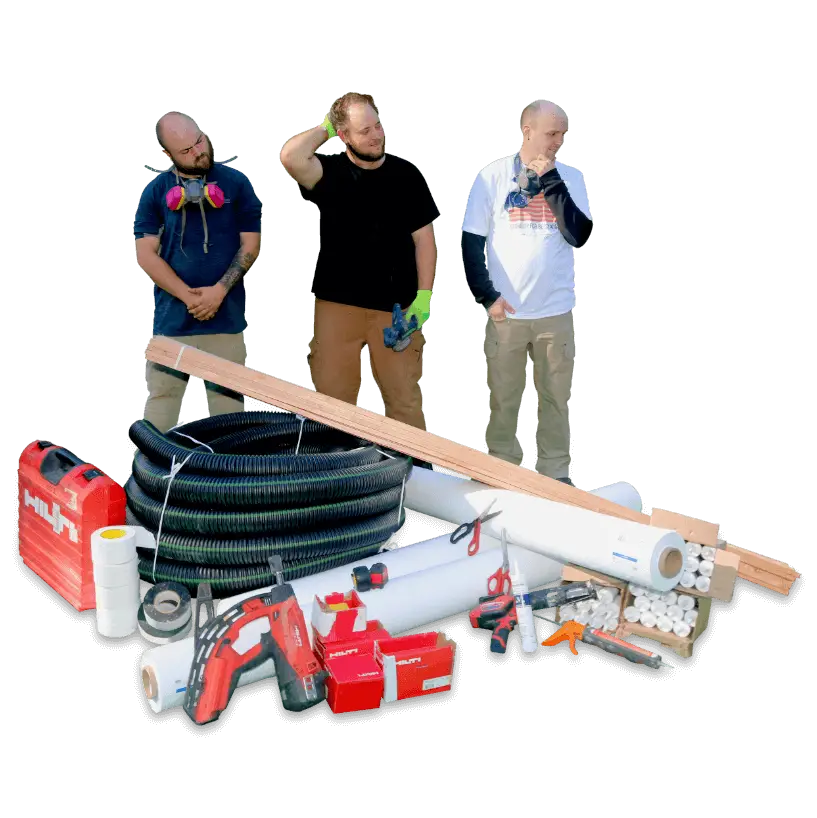
30+ Manhours and Piles of Materials.
Crawlspace encapsulation is slow, expensive, and will deteriorate over time.
30+ Manhours and Piles of Materials.
Crawlspace encapsulation is slow, expensive, and will deteriorate over time.
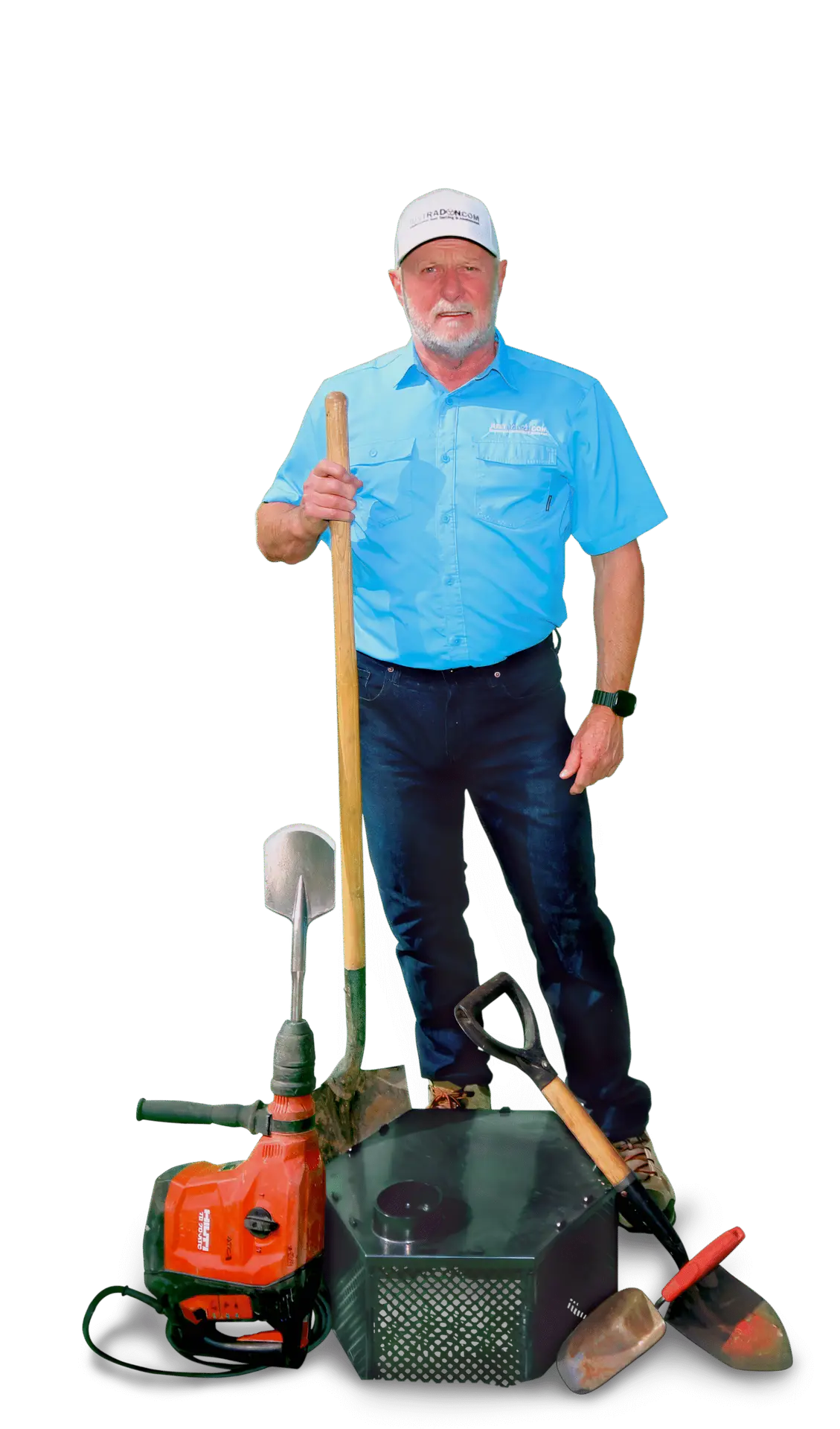
One ol’ guy, a ![]()
… and a shovel. Under 6 hours.
One ol’ guy, a ![]()
… and a shovel.
Under 6 hours.
5x faster and 1/3 less than encapsulation
Performance Highlights
Radon routinely reduced to under 2.0 pCi/L.
Installs in less than
6 hours
Designed for crawlspaces, slabs, and hybrid foundations.
Cuts material cost by up to 20%+ and labor costs by 40%+ vs. full encapsulation
Comparison
Install Time
Encapsulation
16-30+ Man hours
- 6 Man Hours
Material Cost
Encapsulation
$1,500+
- $1,199
Labor Requirement
Encapsulation
Very HIGH
- Very LOW
Product Life
Encapsulation
5-15 years
- Forever
| Encapsulation |
|
|
|---|---|---|
| Install Time | 16–30+ Man hours | 6 Man hours |
| Material Cost | $1,500+ | $1,199 |
| Labor Requirement | Very HIGH | Very LOW |
| Product Life | 5–15 years | Forever |

Proven Results in the Field
(After 459 RadonWell® Installations)
Avg. Original
Radon Level
Avg. Post-Mitigation
Radon Level
Average Radon Reduction
$1,199.00
MSRP - (RadonWell® only)
Professional Installation Required
Mitigator Pricing is available through the
RadonWell® Authorized Installer Portal
The RadonWell® removes radon, VOCs, and other soil gasses at the source…
from under the ground. Not beneath the plastic vapor barrier.
It can also remove up to 40 gallons of moisture a day.
There is no downside to having a RadonWell® installed.
The Results are Astonishing
Real homes. Real results.
See how homeowners across the country reduced radon levels with a RadonWell®.
Christopher Smith
Hillsdale Radon, NRPP# 115713-RMS
This home was built in the early 1900s and included an original Michigan fieldstone basement along with two additions, each with its own crawlspace. After discovering the basement floor had been filled with concrete and covered with a vapor barrier, we installed the RadonWell in the larger crawlspace near the center of the space.
We dug a 24-inch hole, set the top of the well 14 inches below the soil surface, and ultimately installed a Festa Eagle Extreme fan.
Pre-mitigation radon levels were 8.3 pCi/L. Post-mitigation levels came in at 0.4 pCi/L.
The installation took about 6 hours. Without a RadonWell, this would have been a two-day job and possibly stretched into a third.
The homeowner was very excited to see radon levels reduced from 8.3 pCi/L to 0.4 pCi/L.
Tyler Lucas
Lucas Contracting, NRPP# 109372-RMS
This crawlspace was nearly impossible to access, with most areas under 12 inches high and a separating footer wall splitting the space in two. The crawlspace also contained dry-stacked piers, HVAC ducting, plumbing, gas lines, unsupported electrical wires, and extremely dry, dusty soil with no vapor barrier installed. Every movement created a dust storm.
The RadonWell® was installed beside and underneath the separating footer wall using 4-inch PVC connected to a RadonAway RP265 fan generating 120 CFM. The entire installation took 4 hours while working almost entirely on my belly. Without the RadonWell®, this project would likely have taken 5 to 6 days.
Pre-mitigation radon levels were 41 pCi/L. Post-mitigation testing with a RadStar CRM averaged 3.5 pCi/L.
The homeowner couldn’t have been happier with the results.
Christopher Rust
Hoosier Radon Remediation, NRPP# 115181-RMS
This job was in an 1,800 sq. ft. crawlspace with a 20 mil vapor barrier already in place and two sump pumps working on what was very high-moisture soil. Radon levels were sitting at 8.9 pCi/L. The crawlspace wasn’t bad to work in, but conditions called for a strategic approach.
We cut a 3′ x 3′ section in the barrier, dug down about 20″, and installed the RadonWell® system with 3″ PVC run through the rim joist to an RP145 fan pulling 1.0″ WC. Within 72 hours, the radon dropped to 0.8 pCi/L. A month later, suction evened out at 0.5″ WC, and the soil under the barrier was bone dry. Another 48-hour test had the radon at 0.7 pCi/L.
The whole installation took a two-man crew just 8 hours. A traditional approach would have taken two technicians more than 12 hours.
The homeowner was ecstatic, not just with the radon reduction but with how much the system helped address the moisture issue.
Matt Andrews
SM Radon Pro, NRPP# 110760-RMS
This was an approximately 800 sq. ft. slab-only home with no usable space to install a traditional mitigation system. The house had a single utility room packed with a furnace, water heater, laundry, and a sink, leaving no place for a suction point. The only unfinished attic space was a shallow, angled storage area that couldn’t accommodate a fan. There was no interior chase or practical routing path, and installing a fan inside the living space was not an option.
The system was designed as an exterior RadonWell® installation. I had to dig through rock to reach a footing depth of roughly three feet. Working solo, and despite the amount of digging involved, the installation took about 5 hours. I wouldn’t have been able to complete this job without a RadonWell.
Pre-mitigation radon levels were 4.5 pCi/L. Post-mitigation levels dropped to 0.4 pCi/L based on the homeowner’s EcoQube monitor.
The homeowner was relieved to have a solution that fit the home’s unique constraints while achieving exceptionally low radon levels.
Joshua Hines
Breathe Wright, NRPP# 115038-RMS
This home had an inaccessible crawlspace, clay soil, and three different foundation types, which limited mitigation options. We installed the RadonWell in the crawlspace and added an exterior sub-slab system using an LV175 fan to ensure adequate coverage.
The RadonWell was installed in about 3 hours with two technicians, followed by an additional 3 hours for one technician to complete the exterior system. Without the RadonWell, this installation likely would not have been possible.
Radon levels dropped from 30 pCi/L to 1.2 pCi/L.
The homeowners were thrilled with the results and pleased to have an effective solution despite the home’s complex foundation conditions.
Riley McHale
RDM Restoration and Move Management, NRPP# 115244-RMS
This home was hundreds of years old, and the basement was a mix of an old slab and dirt. There also wasn’t a good exit point, so we sealed an old window and used that as the exit. I installed the RadonWell in the corner of the basement and dug a hole about 15–20 inches deep. We used an AprilAire ARN 25F radon fan for the system.
Pre-mitigation radon levels were 11 pCi/L. Post-mitigation levels came in at 3 pCi/L using a CRM from Airthings.
The full installation took about 5 hours. Without a RadonWell, this would have taken me 2–3 days, and other mitigation approaches would not have been cost-effective for this project.
The homeowner was grateful for the cost, speed of the installation, and especially the initial result.
Eric Holm
Just Radon, NRPP# 109480-RMS
This was the first installation of the RadonWell prototype in a crawlspace. The install was set up like a sub-slab system. I buried the prototype near the garage foundation with about 4 inches of soil on top to simplify routing. The soil was dense but dry, so I installed a high-suction AMG Eagle Extreme fan in the garage attic.
Pre-mitigation radon levels were 12.2 pCi/L, and the RadonWell reduced them to 1.4 pCi/L. The installation took 4–5 hours, compared to more than 20 hours for a traditional crawlspace encapsulation approach.
The homeowner was thrilled to achieve such a significant radon reduction without the time, expense, and disruption of a full encapsulation project.
Brian Notestein
Purple Mountain Radon, NRPP# 113262-RMS
Limited headroom in the crawlspace was the biggest obstacle. The space was divided by a stem wall with the furnace on the other side, which added to the layout complexity. I dug a 29-inch hole next to the stem wall and set the RadonWell so the top sat 18 inches below the surface. A smoke pen showed a slight air leak at the surface, so I sealed it with a layer of 6-mil vapor barrier. A week later, I found another small leak at the edge of the stem wall and sealed it with cement.
I used a Festa Eagle fan pulling 2.6 inches WC and moving 105 CFM. After 24 hours, radon dropped from 8.7 pCi/L to below 1.0 pCi/L, with lows at 0.3 pCi/L. The post-mitigation charcoal test came in at 0.8 pCi/L, and the installation took about five hours.
The homeowner said she had never seen her radon levels drop that low.
Eric Holm
Just Radon, NRPP# 109480-RMS
I installed a RadonWell in the crawlspace of a 1,900 sq. ft. split-level home. There was no inconspicuous place to install a sub-slab system, and the homeowner didn’t want a suction pipe visible anywhere in the house. The crawlspace had to be opened anyway, so I installed a RadonWell.
The crawlspace was pretty tight, but I was able to bury the RadonWell about 10 inches below the ground. This was the second installation of the day, and we were finished in less than 3 hours.
Radon levels were reduced from 5.1 pCi/L to 0.2 pCi/L.
The homeowner was very happy to achieve such low radon levels without having a visible suction pipe installed inside the home.
Josh Cowden
Just Radon, NRPP# 115312-RMS
We used a RadonWell in a basement with a dirt floor. It took about 45 minutes to bury the RadonWell and another couple of hours to complete the pipe runs and install the fan.
The home’s radon levels were originally 13 pCi/L and were reduced to 0.4 pCi/L. The neighboring rental property, which sits on the same geology and had been mitigated the previous year using a traditional sub-slab system, achieved similar results at 0.3 pCi/L.
The homeowner was pleased to achieve exceptionally low radon levels with a system that was installed quickly and efficiently.
To find an Authorized Installer, click on your state below
To Become an Authorized Installer and
Receive Wholesale Pricing, Complete This Form
There's no cost to become an Authorized Installer. Authorized installers receive professional training, exclusive product resources, real-world case studies, recommended tools, and proven solutions for complex installations.
Frequently Asked Questions
What does a RadonWell® do?
The RadonWell® removes radioactive radon gas from the soil before it enters your home. It is engineered to pull out radon gas, other soil gases, VOCs, petroleum fumes, and moisture from the ground under your building.
How much will my radon go down with a RadonWell®?
RadonWell® installations regularly reduce indoor radon levels to below 2.0 pCi/L on average. Results may vary depending on soil and house construction, but consistently low levels are the real benefit.
Does a RadonWell® only remove radon?
Will a RadonWell® help with moisture problems?
Yes, when the moisture is coming from the soil as vapor. Radon is heavier than a water molecule, so the same airflow that removes radon also removes vapor that would otherwise be released into the crawl space air.
It will not fix surface leaks, puddles, or flooding. But when moisture comes from the ground, a RadonWell® helps remove it before you smell it, feel it, or see it.
Does the RadonWell® provide immediate relief?
The RadonWell® will provide measurable results immediately. It depends on the moisture content of the soil, soil make-up, and the density of the soil the system is pulling through. Moisture has volume, and as the water volume is removed, razor-thin cracks are formed in the soil, like in the desert during the summer. As the RadonWell® dries the soil, the pressure field created by the system expands, which removes more moisture and soil gases. Whatever the radon level is immediately after the installation, it will be drawn down even more over time. It can take up to 12 months for the RadonWell® to reach full effectiveness.
Can a RadonWell® reduce odors?
Yes. Musty or earthy smells often come from soil gases and water vapor interacting with the dirt, wood, insulation, or other organic materials under the home. Remove the gases and moisture at the source, and the smell never forms.
Who installs a RadonWell®?
A RadonWell® is the cornerstone of an active soil depressurization system. It must be installed by an approved mitigation professional. Use our installer map to find an Authorized RadonWell® Installer near you.
If your region does not show an approved installer, we may be vetting one now. Contact us, and we’ll help connect you with one. [email protected]
Does a RadonWell® need maintenance?
The RadonWell® needs no maintenance… ever. However, it’s part of a sealed, active subsoil system that includes a fan. The only moving part is the fan that creates the negative pressure. As long as the fan is running, the RadonWell® is working. The fan may need to be replaced after years of service.
How long does a RadonWell® last?
A RadonWell® is a permanent system that stays buried for the life of the structure. The mitigation fan lasts many years and can be replaced if needed without disturbing the RadonWell®.
Where is a RadonWell® installed?
A RadonWell® is buried under the ground, usually in the crawlspace, but sometimes outside next to the structure. A suction pipe connects to the RadonWell® and is routed to a mitigation fan. The fan is usually installed outside the home, sometimes in an attic, and the system ejects the gases safely above the roof.
Is a RadonWell® quiet?
Yes. The fan used to power a RadonWell® is exterior-rated. If you stand next to it, you may hear a hum. Because a radon fan is a mechanical device, it’s not silent; it will make some noise. Whatever noise it does make is constant; it doesn’t modulate, which means that it’ll turn to white noise after a few days.
Do I need plastic or a vapor barrier with a RadonWell®?
Sometimes. If you already have a crawlspace barrier, a RadonWell® works with it. It is not dependent on plastic to remove soil gases. If you have crevices in the soil, a thin vapor barrier may need to be laid out over the ground, as the cracks in the ground will defeat the negative pressure required to remove the soil gases. Encapsulation is NOT required.
Is RadonWell® safe for kids and pets?
Yes. A RadonWell® does not release chemicals. It simply removes the soil gases originating in the ground. There’s no downside to a RadonWell® installation.
How do I know if I need a RadonWell®?
Start with a radon test. If your test shows a radon level you’re not comfortable with, or if your crawlspace has odors or moisture vapor from the soil, a RadonWell® may be recommended. If you are unsure, contact an authorized installer. They’ll let you know if your home is a good fit.